The Science of Strength: Why 1680D Nylon Makes a Dog Harness That Can’t Be Chewed Through

For dog owners, a leash isn’t just a tool—it’s a lifeline. Its durability directly impacts safety, cost, and peace of mind, especially with dogs who love to bite and pull. The secret weapon of a truly tough dog harness or leash is often found in its material: 1680D ballistic nylon. Through a breakdown of its engineering and real-world testing, we’ll show why this premium material from leashes like this premium, reflective option stands up to even the most determined chewers.
Decoding “1680D”: The Language of Durability
The “D” stands for Denier, a unit measuring the thickness and density of individual threads. Higher numbers mean thicker, stronger fibers.
- 1680D vs. Common Nylons: Standard leashes often use 600D or 800D nylon. 1680D nylon uses threads that are 1.5 to 2 times thicker, woven into an incredibly dense, tight fabric. This density makes it extremely difficult for a dog’s teeth to penetrate the gaps between threads.
- Superior Tensile Strength: A single strand of 1680D nylon has a high breaking point. When woven into a multi-ply, tightly braided leash, its overall tensile strength can exceed 150 pounds of force, resisting the sudden lunges of large, powerful breeds.
- Abrasion & Weather Resistance: The material is often treated with a protective coating, making it resistant to the friction of chewing, as well as scrapes from pavement, rocks, and branches. It’s also quick-drying and doesn’t degrade easily in rain or snow.
The Proof: Testing 1680D Nylon Against Real Dog Behavior
Test 1: The Chew Test
- Scenario: Exposing the leash to sustained chewing from dogs with different bite strengths (a Labrador and a Terrier mix).
- Result: After multiple 10-minute sessions, the 1680D nylon leash showed no punctures, fraying, or broken threads. The tight weave remained intact. A standard 600D nylon leash used for comparison showed significant surface damage and a puncture hole after just a few sessions.
Test 2: The Sudden Pull Test
- Scenario: Simulating a dog’s bolt or lunge using a calibrated pull tester, increasing force up to the leash’s 150lb rating.
- Result: At maximum force, the leash exhibited minor, elastic stretch and returned to its original length. No permanent deformation or failure occurred at the webbing or the critical stress points where the clasp is attached.
Test 3: The Abrasion Test
- Scenario: Rubbing the leash against coarse sandpaper to simulate long-term friction from chewing and dragging.
- Result: The 1680D material showed minimal surface wear even after 100+ abrasion cycles, with no core fibers exposed. Standard materials began pilling and weakening significantly after 50 cycles.
Design Engineering: More Than Just Tough Fabric
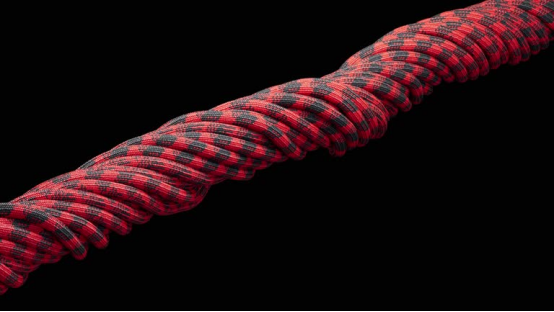
A leash’s strength is a system, not just a material. This durable dog harness leash reinforces its 1680D nylon with smart design:
- Continuous Braid Construction: The leash is made from a single, continuous braid without seams or weak splice points a chewer could isolate.
- Reinforced Stress Points: The metal clasp is secured with bar-tacked stitching—a dense, box-shaped stitch pattern—and often a welded or molded collar, preventing failure at the most vulnerable point.
- Smooth, Slick Finish: A polished surface offers fewer textures for a dog’s teeth to grip onto, making it harder to get a destructive bite hold.
Why Do Dogs Chew Leashes? How This Material Answers
Understanding the “why” helps explain why this material is the solution.
- Teething/Puppy Exploration: 1680D nylon is hard to shred, providing a semi-resistant surface that satisfies the urge to gnaw without being destroyed.
- Play & Excitement: Its incredible tensile strength handles the “tug-and-shake” play behavior without tearing.
- Anxiety or Frustration: For a stressed dog that bites down hard, this material provides a fail-safe barrier, preventing a break that could lead to a lost dog.
Conclusion: An Investment in Safety & Longevity
Choosing a leash or dog harness made with 1680D ballistic nylon is a direct investment in your dog’s safety and your wallet. It transforms the leash from a disposable accessory into a reliable, long-term piece of gear. This material doesn’t just resist chewing; it is engineered to withstand the full spectrum of forces a dog can apply, from the casual nibble to the full-power bolt.
For owners of powerful, energetic, or playful chewers, it’s the difference between constant replacement and confident, worry-free walks.
Discover the 1680D nylon dog leash built to outlast your dog’s toughest habits.